

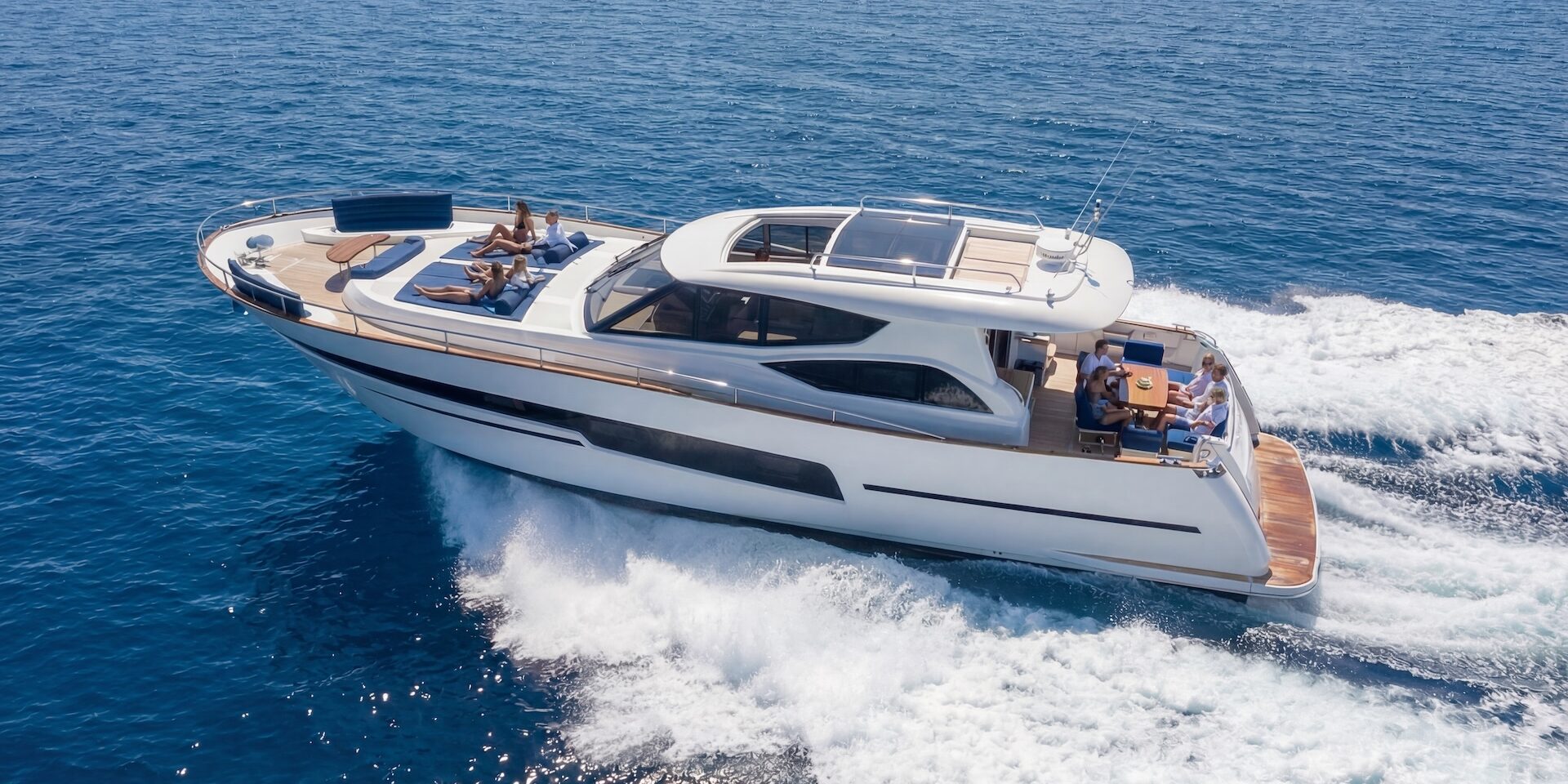
Choosing the right yacht configuration shapes far more than exterior design. It determines where people gather, how connected the helm feels to the social area, how much protection the boat provides, and how comfortably owners can extend the cruising season. Flybridge, Sport Top, and Hard Top yachts each create a distinct lifestyle on the water, with no single option being universally superior.
Flybridge: maximum outdoor living and panoramic views
A Flybridge adds an upper deck with a second helm station, seating, and often a sunbathing or dining area. This creates another complete social zone without reducing the main cockpit or interior saloon.
The elevated position provides excellent visibility while cruising, approaching an anchorage, or navigating between islands. Guests can remain close to the helm, making the journey itself part of the shared experience rather than simply the time spent travelling between destinations.
Its principal advantages include:
- Generous outdoor living space
- Panoramic visibility from the upper helm
- Separate areas for entertaining, dining, and relaxing
- Greater privacy between different groups on board
- A sheltered aft cockpit beneath the upper deck
A Flybridge is especially attractive for families and owners who regularly welcome guests. Children may use one deck while adults relax on another, or the upper area can become a private retreat when the cockpit is busy. It also suits owners who see cruising as a slow, social experience rather than only a means of reaching the next bay. If lunch at anchor, sunset drinks, and spending entire days outside are central to the yacht lifestyle, a Flybridge often feels naturally accommodating.
The main practical consideration is exposure. Although a bimini or retractable shade can protect the Flybridge from strong sun, the upper station remains more affected by wind and changing weather. Access also requires stairs, which should be evaluated according to the mobility of everyone who will regularly use the vessel.
Sport Top: open-air energy with integrated protection
A Sport Top yacht generally combines an open, performance-oriented character with a substantial roof over the helm and main cockpit or social area. Depending on the design, the roof may incorporate a large opening section that transforms the covered area into a more open-air environment.
This configuration keeps the helm closely connected to the main social space. The driver, passengers, and guests can interact easily while cruising, which makes a Sport Top particularly suitable for sociable day trips, swimming excursions, and short island-hopping itineraries.
Compared with a Flybridge, the boat normally has a lower profile and a more immediate connection with the water. Movement between the helm, cockpit, bathing platform, and deck areas feels natural, while the integrated roof offers shade when needed.
A Sport Top suits owners who value:
- A sporty, contemporary yacht lifestyle
- Strong communication between the helm and cockpit
- Flexible sun and shade
- Easy access to outdoor entertaining areas
- A lower, streamlined profile
It often appeals to owners who want the atmosphere of an open boat without giving up all-weather practicality. For couples, smaller groups, or owners who prefer everyone to remain in one shared area, this yacht configuration can feel especially intuitive. On models such as the (MY 70 ST), the appeal lies in this balance between protection, flow, and a strong sense of connection to the sea.
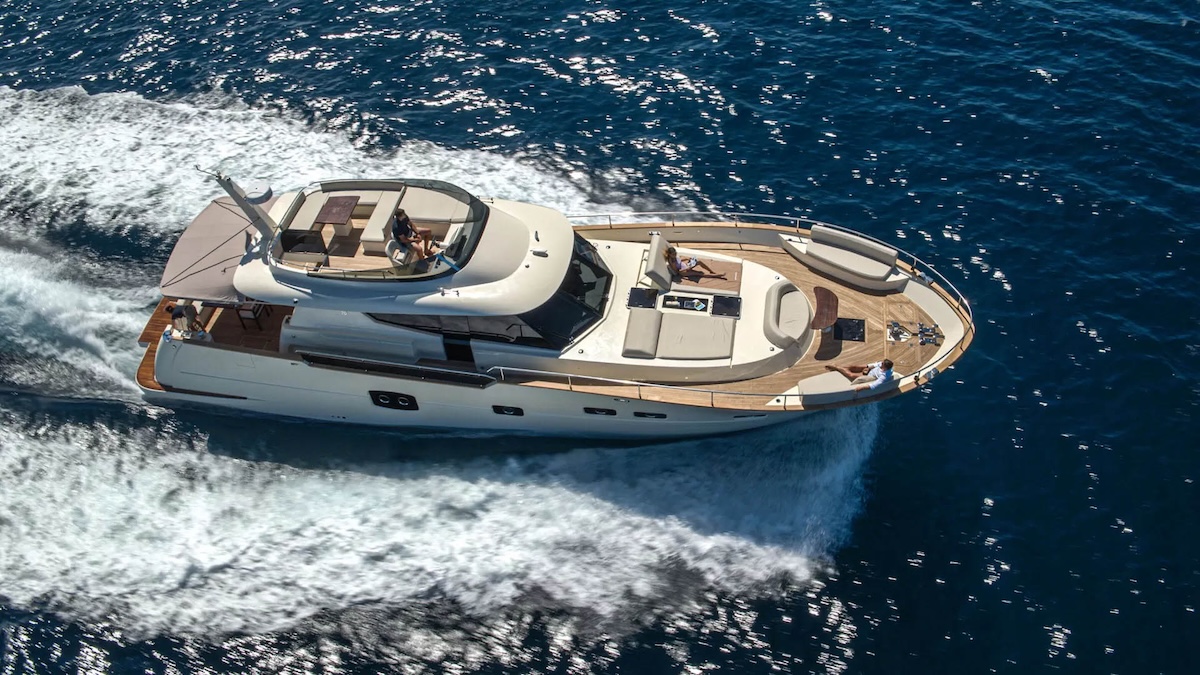
Protection is generally greater than on a fully open boat but usually less complete than in a more enclosed Hard Top configuration. Privacy may also be more limited because navigation and social activities take place within the same principal area. As with all such labels, exact interpretation varies by builder and yacht layout.
Hard Top: dependable shelter and extended-season comfort
A Hard Top generally places greater emphasis on protection from sun, wind, spray, and cooler conditions. Its fixed structure creates a sheltered helm and saloon while large windows preserve visibility and natural light.
This type of yacht is well suited to owners who cruise frequently rather than only in perfect weather. It supports comfortable early-morning departures, longer passages, and voyages during spring or autumn. Climate control is also more effective in a protected interior than in a predominantly open deck area.
Key benefits include:
- Reliable weather protection
- A quieter and more private interior
- Comfortable cruising across a wider range of conditions
- Secure storage and enclosed living space
- Clear separation between interior comfort and outdoor relaxation
A Hard Top does not necessarily mean sacrificing contact with the sea. Opening side doors, sliding glass panels, sunroofs, and an intelligently designed aft deck can create a smooth transition between the saloon and cockpit. The quality of that connection is more important than the configuration label itself.
For owners planning longer stays on board, more varied itineraries, or a schedule not limited to peak summer, a Hard Top can be the most relaxing choice over time. It is often less about dramatic first impressions and more about day-to-day ease: quiet passages, dependable shade, protected dining, and a comfortable retreat when the weather becomes less predictable. Depending on the design, it may also offer the greatest sense of privacy for owners who value a more enclosed onboard atmosphere.
Yacht configurations at a glance
| Feature | Flybridge | Sport Top | Hard Top |
|---|---|---|---|
| Outdoor living | Excellent | Excellent | Good |
| Weather protection | Moderate | Good | Excellent |
| Helm visibility | Excellent | Very good | Very good |
| Privacy | Very good | Moderate | Excellent |
| Social cruising | Excellent | Excellent | Very good |
| Extended season | Good | Good | Excellent |
| Mediterranean use | Excellent | Excellent | Excellent |
The hull design, engine arrangement, vessel size, stability, and performance remain important, but they should be considered alongside daily life on board. Even the right boat on paper can feel unsuitable if its social spaces do not support the owner’s preferred routine.
Choosing for Mediterranean cruising
Mediterranean cruising often involves long periods outside, short passages between islands, sheltered anchorages, swimming, and relaxed meals on deck. A Flybridge takes full advantage of warm evenings and expansive coastal views. A Sport Top makes moving between cruising, anchoring, and swimming particularly effortless. A Hard Top provides welcome shade during intense summer heat and better protection when local winds or seasonal conditions change.
Prospective owners should consider where breakfast will be served, whether guests will join the helm during a passage, how often the yacht will remain at anchor, and whether cruising will continue outside July and August. These practical details reveal more than comparing speed, engine output, or available space alone.
At its Croatian shipyard near Split, Monachus Yachts develops boats for real Adriatic and Mediterranean conditions. Its semi-custom approach allows elements of the deck, equipment, materials, and living areas to reflect individual priorities, supported by direct communication with the shipyard and sea trials in the Adriatic. The most appropriate configuration is ultimately the one that feels natural during every hour spent aboard.
1 Comment